When two neutron stars collide and merge, how long can we see their high-energy emission? Until now, the familiar signature has been a short gamma-ray burst lasting less than two seconds. A new discovery by the Einstein Probe (EP, also known as Tianguan) shows, however, that the end of the gamma-ray burst does not mean this cosmic explosion is over.
Recently, Professor Bin-Bin Zhang of the School of Astronomy and Space Science, Nanjing University, together with collaborators from the EP collaboration in China and abroad, carried out an in-depth study of EP250704a/GRB 250704B, a high-energy burst produced by a compact object merger. The burst was captured simultaneously by EP, the China–France SVOM satellite and the Insight-HXMT satellite, which monitored it in full in soft X-rays and gamma rays respectively, offering a rare opportunity to trace the early evolution of the emission from a compact object merger. The study finds that the short gamma-ray burst, which lasted less than half a second, was followed by a “hidden” episode of soft X-ray activity lasting nearly ten minutes, indicating that the merger remnant continued to release substantial energy for a considerable time. This implies that compact star mergers—important sources of gravitational waves—can also appear as fast X-ray transients lasting several minutes, opening a new observational window for the search for electromagnetic counterparts of gravitational-wave events and for multi-messenger astronomy. The results were published in the journal Science Bulletin under the title “Minutes-long soft X-ray prompt emission from a compact object merger”. The work was jointly led by Nanjing University, the University of Rome “Tor Vergata”, the University of Hong Kong and the National Astronomical Observatories of the Chinese Academy of Sciences, with Nanjing University as the first corresponding-author institution.
Capturing Minutes-long Soft X-ray Emission
Short gamma-ray bursts (GRBs) are among the most violent explosions in the Universe and are generally thought to originate from the merger of compact objects such as binary neutron stars. These collisions not only produce intense high-energy electromagnetic radiation but are also important sources of gravitational waves. For decades, our understanding of these events has come mainly from gamma-ray observations, and what their prompt emission looks like at lower energies, in soft X-rays, has remained largely unobserved. This is because conventional X-ray telescopes have small fields of view and usually have to wait for a gamma-ray satellite to trigger on and localize a burst before slewing to the target, making it very difficult to catch the earliest soft X-ray emission of an explosion. Launched in January 2024, EP is capable of wide-field soft X-ray monitoring and fills this observational gap.
On July 4, 2025, An Li, a PhD student at Beijing Normal University who was serving as the EP transient advocate on duty that day, received the onboard trigger alert from EP’s Wide-field X-ray Telescope (EP-WXT) for EP250704a/GRB 250704B and quickly carried out a preliminary analysis. At first, the event looked much like an ordinary short GRB: the gamma-ray burst monitors SVOM-GRM and Insight-HXMT detected a short GRB lasting less than half a second (about 0.4 s), and EP-WXT simultaneously recorded a brief X-ray spike—such a sharp leading spike had never before been seen among the fast X-ray transients detected by EP. However, once the brief gamma-ray flash was over, EP did not see the signal simply disappear. Instead, it continued to detect several episodes of soft X-ray activity that lasted nearly ten minutes in total.
Professor Bin-Bin Zhang of the School of Astronomy and Space Science at Nanjing University, a co-corresponding author of the paper, then initiated and organized an in-depth study of the event. The analysis shows that although this minutes-long emission carried substantial energy, its spectrum was very soft. For a burst at such a cosmological distance, extrapolating the signal to higher, gamma-ray energies places it below the detection threshold of conventional GRB instruments such as the Burst Alert Telescope (BAT) aboard the Swift satellite—in other words, had the event been monitored only in gamma rays, all that would have been seen is the flash lasting less than half a second. This implies that many short GRBs observed in the past may also have been accompanied by similar long-lasting soft X-ray activity that conventional GRB detectors simply could not capture. “Our observations show that what appears to be a typical short gamma-ray burst can actually conceal a much longer and richer episode of activity at soft X-ray energies,” said Professor Zhang.
To determine the physical origin of the burst, the team organized an international follow-up campaign spanning X-ray, optical and radio wavelengths. EP’s Follow-up X-ray Telescope (EP-FXT) automatically slewed to the target after the trigger and localized the fading X-ray afterglow, while the Very Large Array (VLA) detected its radio afterglow. The group of Professor Eleonora Troja of the University of Rome “Tor Vergata”, a co-corresponding author of the paper, obtained the key redshift measurement from spectroscopy with the European Southern Observatory’s Very Large Telescope (VLT), establishing the burst’s cosmological distance (a redshift of about 0.66, meaning that its light traveled for more than six billion years to reach Earth). At this distance, the peak energy and the total energy of the burst’s gamma-ray emission both fall within the range of merger-driven GRBs. Subsequent deep optical observations found no sign of the supernova that usually accompanies the collapse of a massive star, further supporting a compact object merger, rather than a massive-star collapse, as the origin of the burst.
Where Does the Long-lasting X-ray Emission Come From?
Where does the nearly ten-minute-long X-ray emission come from? The team found that it was not produced by the outward-expanding blast wave interacting with the surrounding medium, but more likely came directly from the activity of the central engine after the merger. Yi-Han Iris Yin, a PhD student at the University of Hong Kong and a co-corresponding author of the paper, led the analysis of the high-energy emission. Combining the burst’s rapid variability, its spectral evolution and the properties of the subsequent X-ray and optical afterglows, she found that the central engine remained active and kept injecting energy after the initial short GRB, which lasted less than a second, had ended. One plausible explanation is that the merger did not immediately produce a black hole but instead formed a rapidly rotating, highly magnetized neutron star known as a magnetar. A newborn magnetar can keep releasing energy, powering the long-lasting X-ray emission and the continued energy injection.
Fast X-ray Transients Bring New Clues in the Search for Gravitational-wave Sources
Since the first joint detection of gravitational waves and electromagnetic signals from a binary neutron star merger in 2017, the search for electromagnetic counterparts of gravitational-wave sources has become a major direction of multi-messenger astronomy. Previously, long-lasting prompt emission had been identified in only about 10%–15% of merger-driven GRBs, and our knowledge of the early X-ray emission of short GRBs relied on the decaying tails caught by the Swift satellite after it slewed to the burst; the onset and evolution of this emission had never been directly observed. The discovery of EP250704a shows that fast X-ray transients lasting several minutes can also originate from compact object mergers, providing a new clue in the search for electromagnetic counterparts of gravitational-wave events. The team believes that EP250704a is unlikely to be an isolated case. As EP continues its wide-field soft X-ray survey, more such events are expected to be found, building a new sample of fast X-ray transients from compact star mergers. This will make it possible to investigate whether a merger produces a black hole or a neutron star, how long a newborn magnetar can survive, and the properties of matter at extreme densities, providing new observational constraints on the neutron star equation of state.
“This discovery demonstrates Einstein Probe’s unique capability to uncover new classes of transient phenomena,” said Professor Zhang. “As gravitational-wave and multi-wavelength electromagnetic observations become more closely integrated, Einstein Probe is poised to play an even more important role in the era of multi-messenger astronomy.”
About the Authors
The co-first authors of the paper are An Li (PhD student, Beijing Normal University), Dr. Chen-Wei Wang (Institute of High Energy Physics, Chinese Academy of Sciences), Niccolò Passaleva (PhD student, Sapienza University of Rome) and Jie An (PhD student, University of Chinese Academy of Sciences). The co-corresponding authors are Professor Bin-Bin Zhang (Nanjing University), Professor Eleonora Troja (University of Rome “Tor Vergata”), Yi-Han Iris Yin (PhD student, the University of Hong Kong), Dr. Jing-Wei Hu and Dr. Hua-Li Li (National Astronomical Observatories, Chinese Academy of Sciences). Yi-Xuan Shao, a PhD student at the School of Astronomy and Space Science, Nanjing University, and Professor Ping Zhou of the same school also took part in the research.
This research was supported by the National Key R&D Program of China, the National SKA Program of China, the National Natural Science Foundation of China, the science research grants from the China Manned Space Program (CSST), the Fundamental Research Funds for the Central Universities, and the Program for Innovative Talents and Entrepreneurs in Jiangsu.
Paper link: https://doi.org/10.1016/j.scib.2026.08.021
Illustration
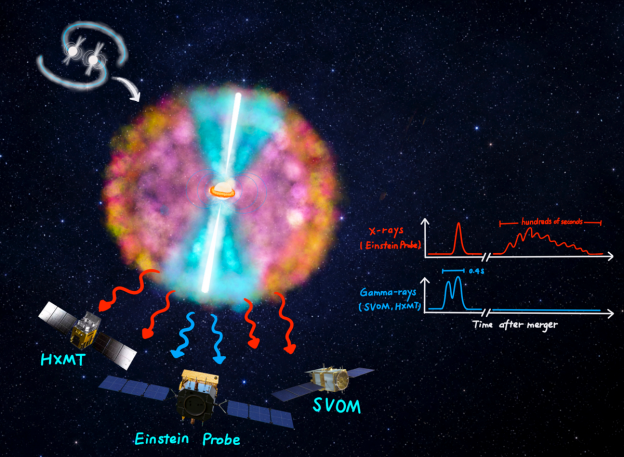
Artist’s impression of a binary compact star merger releasing high-energy radiation. Einstein Probe observed soft X-ray emission lasting nearly ten minutes after the merger. The inset schematically compares the duration of the burst’s emission in X-rays and gamma rays. (Credit Yi-Han Iris Yin, HKU; reference imagery: EPSC, SVOM collaboration, NSSDC.)