Two high-energy explosions recorded nearly three decades apart may share a similar oscillatory “clock.” By reanalyzing the short gamma-ray burst GRB 910711 and comparing it with the extragalactic magnetar giant flare GRB 200415A, researchers found not only similar rapid brightness variations but also a harmonic-like structure organized around approximately 360 Hz. Together with spectral and energetic evidence, these findings support a possible magnetar giant flare origin for GRB 910711, offering a new clue to the true nature of these fleeting explosions.
On October 28, 2026, researchers from the School of Astronomy and Space Science at Nanjing University, together with collaborators from Department of Physics and Kavli Institute for Astrophysics and Space Research at Massachusetts Institute of Technology and other institutions, published their findings in Science Advances in a research article entitled “Harmonic brightness oscillations point to magnetar giant flares in rare short gamma-ray bursts.”
What High-Frequency Oscillations Can Tell Us About a Burst’s Origin
Gamma-ray bursts are among the most violent high-energy explosions in the universe, often originating in distant galaxies. Astronomers generally divide them into long and short bursts using a duration of two seconds as the dividing line: long bursts are primarily associated with the collapse of massive stars, while short bursts are primarily linked to mergers of compact objects. In these cataclysmic events, the system that powers a jet moving at nearly the speed of light is known as the “central engine.” Yet its identity remains a central question: is it a black hole drawing in surrounding matter, or a rapidly spinning neutron star with an exceptionally strong magnetic field?
Gravitational waves from binary neutron star mergers offer one way to investigate. Numerical simulations based on general relativity show that, if a merger leaves behind a short-lived hypermassive neutron star, its vibrations can produce kilohertz features in the gravitational-wave signal. This raises an intriguing possibility: could those same vibrations also travel through the jet and leave an imprint on gamma rays?
In 2023, Cecilia Chirenti and collaborators reported kilohertz quasi-periodic oscillations in GRB 910711 and GRB 931101B in Nature [1]. These were brightness variations that repeated approximately, rather than at strictly regular intervals, with characteristic frequencies near 1,000 and 2,600 Hz. Because the frequencies were consistent with expectations from numerical simulations, the signals were interpreted as possible traces of a neutron star remnant surviving briefly after a merger.
However, a complex chain of physical processes separates the central engine from the gamma rays we observe. The radiation generally emerges not beside the engine itself, but within a jet that has already traveled far from it. As the jet evolves and emission from different regions overlaps, rapid variations may be weakened. In a 2025 study published in Nature Astronomy, Run-Chao Chen and collaborators proposed that a strong, ordered magnetic field and a particular emission structure might preserve the engine’s rotational rhythm [2]. Whether vibrations of a merger remnant could be transmitted in the same way, however, still needs to be tested.
This question prompted Professor Bin-Bin Zhang’s team at NJU, together with Ore Gottlieb at MIT and other collaborators, to revisit GRB 910711. They found that its spectrum was unusually hard at low energies: when fitted with a commonly used model, the low-energy spectral index lay well beyond the range allowed by conventional optically thin, nonthermal emission models—a rare feature among short gamma-ray bursts. A blackbody model, by contrast, could describe the spectrum, suggesting that the observed photons might have emerged from a dense, hot environment after undergoing repeated scattering.
That possibility brought the interpretive tension into focus. Even if the engine’s oscillations could reach the jet, how much of their regular rhythm would survive repeated scattering? Photons would follow paths of different lengths, spreading out their arrival times and weakening or even erasing the original modulation. The spectrum and the oscillations could each be explained separately, but fitting them into a single physical picture proved difficult. Explaining both together therefore became central to understanding the event.
“At a conference, Binbin and I discussed whether magnetar giant flares might offer an alternative explanation,” recalled corresponding author Ore Gottlieb. “The similarities that subsequently emerged from the data gave us a reason to pursue that possibility. Understanding which events really come from mergers is just as important as understanding how mergers themselves work.”
Two Explosions with Similar Light Curves
Magnetars are neutron stars with exceptionally strong magnetic fields that occasionally release large amounts of magnetic energy in giant flares. If such a flare occurs in a nearby galaxy, its bright, brief initial flash may remain detectable, while the longer-lasting, faint tail that modulated by the star’s rotation can disappear into the background. The event can consequently look much like a short gamma-ray burst. An unusually hard spectrum may help distinguish the two, but without precise localization, their origins can still be confused.
GRB 200415A provided an important benchmark for testing this alternative. This magnetar giant flare, which originated in the nearby galaxy NGC 253, had also shown kilohertz oscillations: in a 2021 Nature study, Castro-Tirado and collaborators reported signals near 2,132 and 4,250 Hz in its main peak [3].
When the team compared the events, they found that both GRB 910711 and GRB 200415A contained a bright spike lasting approximately 10 milliseconds, followed by weaker emission fading over roughly 100–200 milliseconds. Within the spikes, both also showed fine structure on timescales far shorter than a millisecond. After accounting for detector sensitivity and scaling down the apparent brightness of GRB 200415A, the researchers could reproduce the main features of GRB 910711’s light curve, suggesting that the two might belong to the same class of explosion.
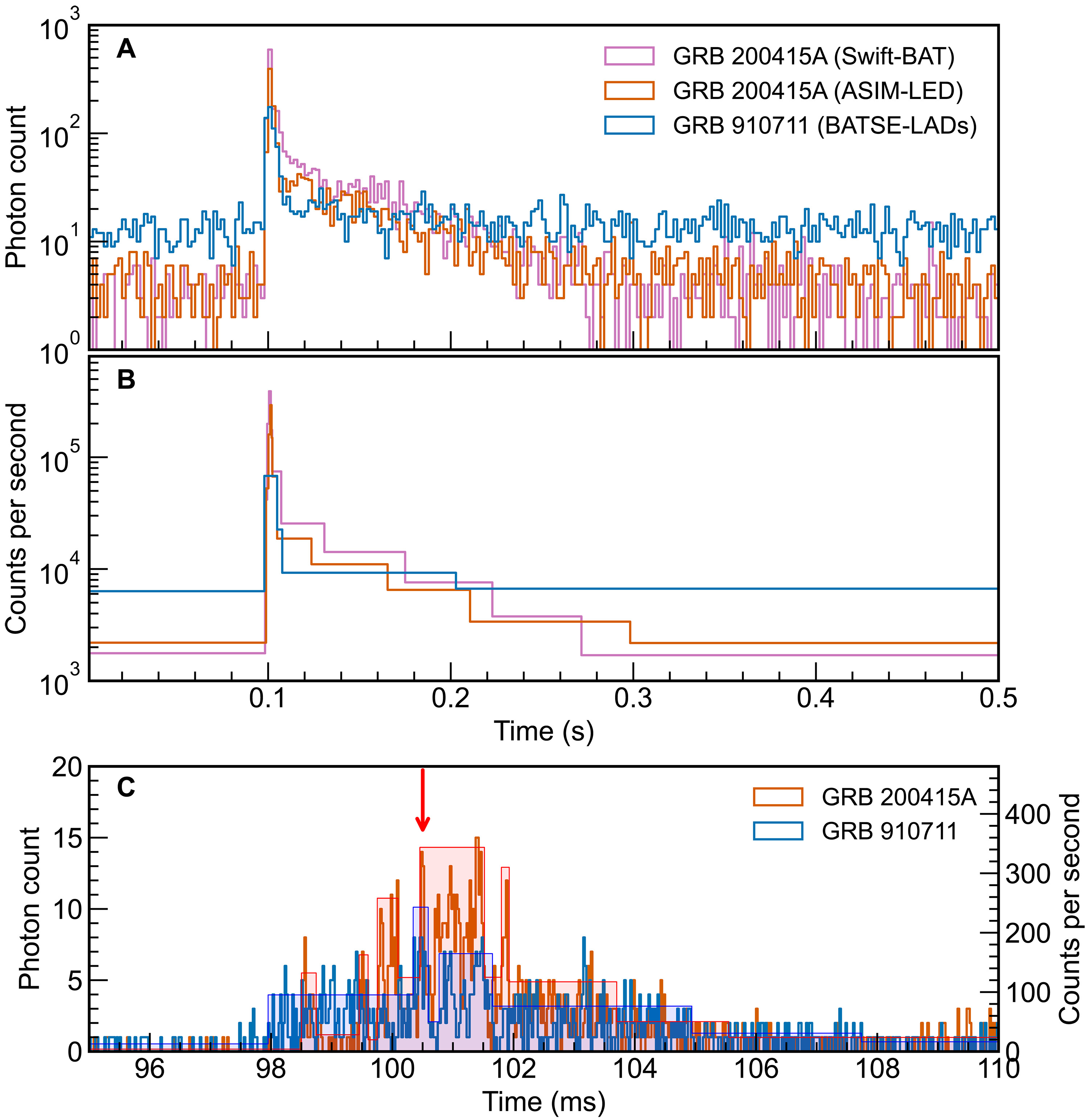
Figure 1. Comparison of the light-curve morphology of the two bursts. Panel A shows the light curves in 2-ms bins; panel B uses segmentation to highlight the bright spike and weaker tail; and panel C zooms in on the initial spike to reveal fine structure on timescales far shorter than a millisecond. Both events exhibit a rapid rise followed by a decay. Source: Figure 1 of the research paper.
Relationships Among Frequencies Offer a Stronger Clue
The similarities extended to the frequencies at which the brightness varied. Both bursts showed quasi-periodic features near 2,100 Hz, along with enhanced signals around 350–360 Hz. On its own, however, the peak near 360 Hz had limited statistical support. A more revealing clue lay in the pattern connecting several frequencies.
The team found that multiple oscillation features in both bursts fell close to integer multiples of 360 Hz, extending above 4,000 Hz. They resembled a series of overtones associated with a common pitch—a harmonic pattern in physical terms. To investigate this relationship further, the researchers used bispectral analysis, which examines two frequencies together with their sum. Some components showed associations consistent with nonlinear coupling, suggesting that they might belong to interconnected oscillatory processes rather than varying independently.
To test whether these features could arise solely from the burst’s light curve profile and random noise, the researchers generated large numbers of simulated light curves by adding photon-counting fluctuations to the fitted burst profiles. They then applied the same bispectral analysis to the simulations as to the observations. Under this hypothesis, the simulations rarely produced a combined signature at the candidate harmonic frequencies as strong as that observed, lending further support to a possible harmonic-like structure.
There are nevertheless clear limits to what the result establishes. A spike lasting about 10 milliseconds contains only three to four cycles at 360 Hz—too few to test reliably whether different components maintain stable phase relationships. For now, 360 Hz should therefore be understood as a characteristic scale describing this set of frequencies, not as an established intrinsic fundamental frequency of the magnetar, and certainly not as its rotation frequency.
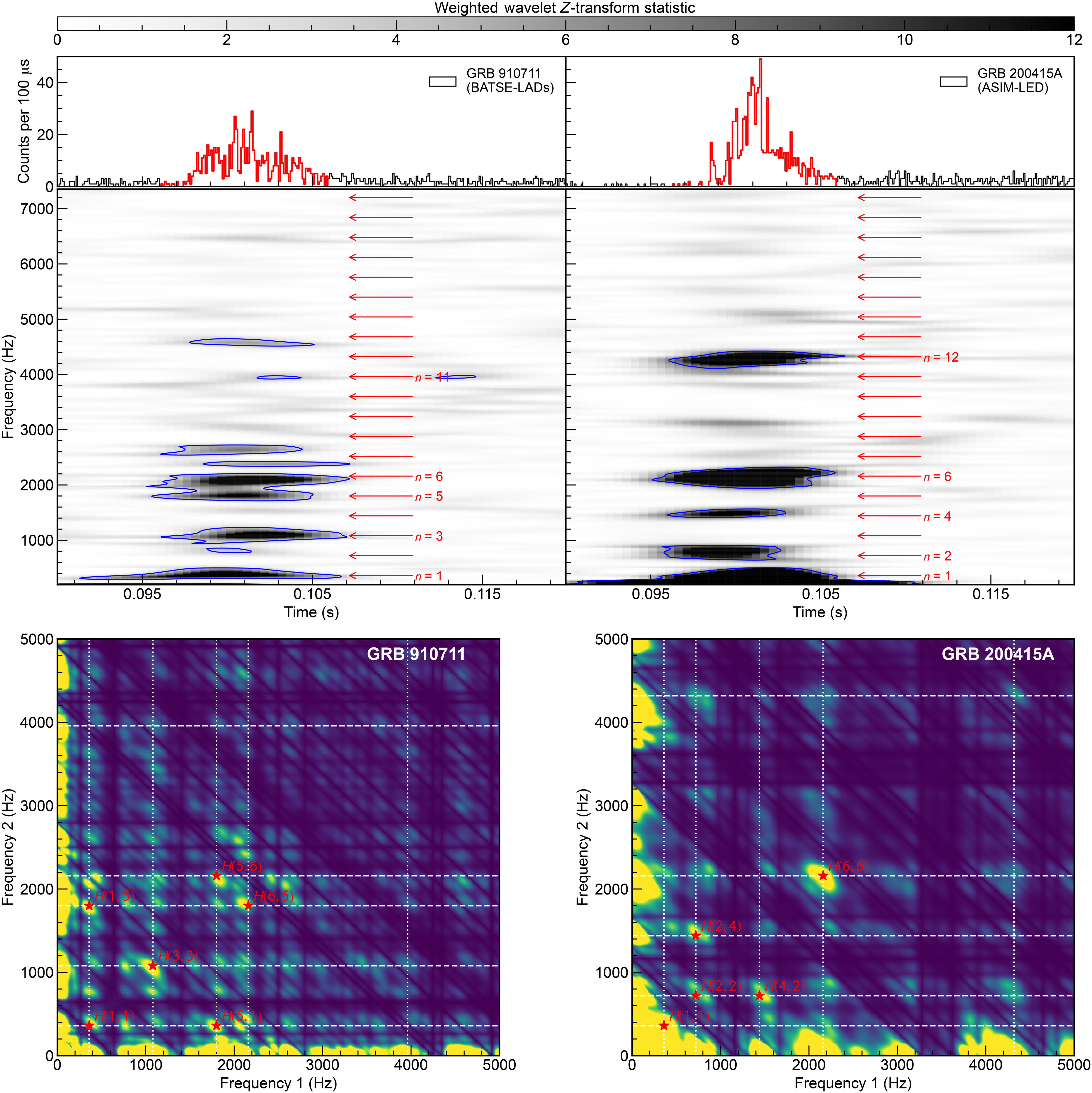
Figure 2. Harmonic-like structures in the two bursts. The upper panels show the light curves and time–frequency spectra, with red arrows marking candidate frequencies close to integer multiples of 360 Hz. The lower panels show the bispectral magnitude distributions, used to examine relationships among the frequencies f₁, f₂, and their sum, f₁ + f₂. Some bright regions correspond to candidate harmonics in the panels above, providing clues to connections among the frequency components without establishing stable phase locking. Source: Figure 3 of the research paper.
Several Lines of Evidence Favor a Magnetar Origin
The energetic analysis also showed that a magnetar interpretation was viable. Because the distance to GRB 910711 remains unknown, the energy it released cannot be determined directly. If it lies within approximately 55 million parsecs, or 180 million light-years, however, the combination of its spectral peak energy and radiated energy could be consistent with known magnetar giant flares. Within the corresponding distance and localization ranges, the team identified 17 potential host galaxies whose photometric properties were more consistent with dwarf galaxies undergoing ongoing star formation. No specific host has yet been established, and the distance range is a condition under which the interpretation is tested, not a measured distance.
Taken together, the similar light curves, unusual spectrum, harmonic-like structure, and compatible energetics support a magnetar giant flare origin for GRB 910711. If confirmed, it could be the earliest extragalactic magnetar giant flare recorded by BATSE. More broadly, the findings suggest that, before using rare high-frequency oscillations to infer the properties of a merger remnant, researchers should also examine whether the explosion itself might have a different origin.
“This kind of structure may provide a new clue for distinguishing these events,” said corresponding author Professor Bin-Bin Zhang. “As more sensitive space detectors collect more photons from such explosions and resolve finer variations in time, this information could become increasingly valuable. Of course, the evidence is not yet conclusive, and we will continue combining theory and observations to investigate where these oscillations come from.”
Why two independent explosions should exhibit a similar frequency scale remains an open question. It could reflect oscillations involving the magnetar’s external magnetic field or its internal structure, but it could also be influenced by the limitations of the data. The current observations do not establish a universal “360-Hz clock.” More sensitive observations and a larger sample of similar events will help test the pattern and investigate how vibrations are translated into high-energy flashes.
“Discovering a rare oscillation is only the beginning,” said first and corresponding author Run-Chao Chen. “The more striking a signal is, the more carefully we need to examine its physical context, using the spectrum, the light curve, and observations at other wavelengths. Finding a rhythm is exciting, but understanding what produces it is the question we really want to answer.”
Paper link:https://www.science.org/doi/10.1126/sciadv.aee6388
First author:Run-Chao Chen
Corresponding authors: Run-Chao Chen, Ore Gottlieb, Bin-Bin Zhang
Funding: This research was supported by the National Natural Science Foundation of China, the National Key Research and Development Program of China, the National SKA Program of China, science research grants from the China Manned Space Program, the Fundamental Research Funds for the Central Universities, and the Program for Innovative Talents and Entrepreneurs in Jiangsu, among other sources. Collaborating authors also received support through a Flatiron Research Fellowship, the Simons Collaboration on Extreme Electrodynamics of Compact Sources, and a Simons Investigator Grant.
References
[1] C. Chirenti et al. (2023). Kilohertz quasiperiodic oscillations in short gamma-ray bursts. Nature, 613, 253–256. https://doi.org/10.1038/s41586-022-05497-0
[2] R.-C. Chen et al. (2025). Evidence for a brief appearance of gamma-ray periodicity after a compact star merger. Nature Astronomy. https://doi.org/10.1038/s41550-025-02649-w
[3] A. J. Castro-Tirado et al. (2021). Very-high-frequency oscillations in the main peak of a magnetar giant flare. Nature, 600, 621. https://doi.org/10.1038/s41586-021-04101-1